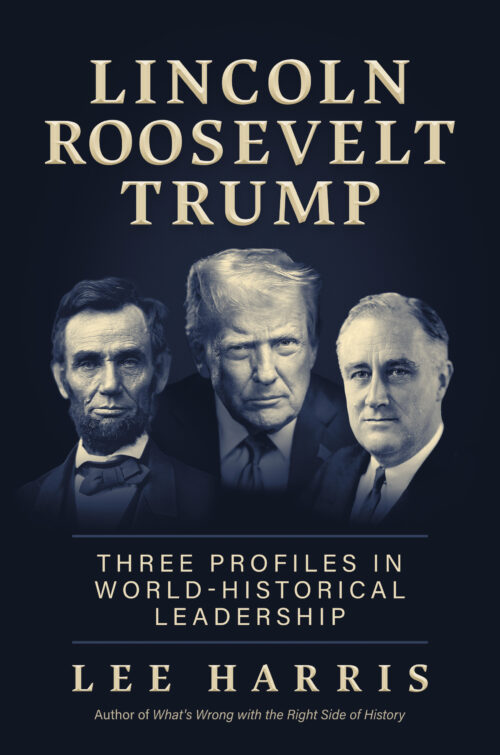

Lincoln, Roosevelt, Trump: Three Profiles in World-Historical Leadership
By Lee Harris
In a startling historical tour de force, Lee Harris argues that Donald Trump is proving to be a world-historical leader worthy of comparison to Lincoln and FDR, our greatest presidents.
Transformational leaders are rarely judged correctly by their contemporaries. Thus, our rosy view of figures such as Abraham Lincoln and Franklin Roosevelt are idealized in retrospect, with their many flaws and errors largely forgotten. Yet these leaders, whom we now judge to be world-historical figures who permanently altered our politics and ushered in a new era in American life, were in their own time intensely polarizing and commonly regarded as dictators. So, what is the truth, and what does it take to become a great leader?
In Lincoln, Roosevelt, Trump, Harris argues the populist revolt of our own time is not a historical fluke, but is an essential aspect of American exceptionalism. At various points in our past, a variety of different elites have aspired to become a de facto ruling class. These populist revolts were often unruly affairs, but without them our nation would have lost its revolutionary claim to be a government of the people, by the people, and for the people.
While it is too soon to judge whether our current president will ultimately rise to the standard set by these great figures of our past, the evidence so far suggests that Donald Trump—love him or hate him—may come to be viewed in the same way by future generations.