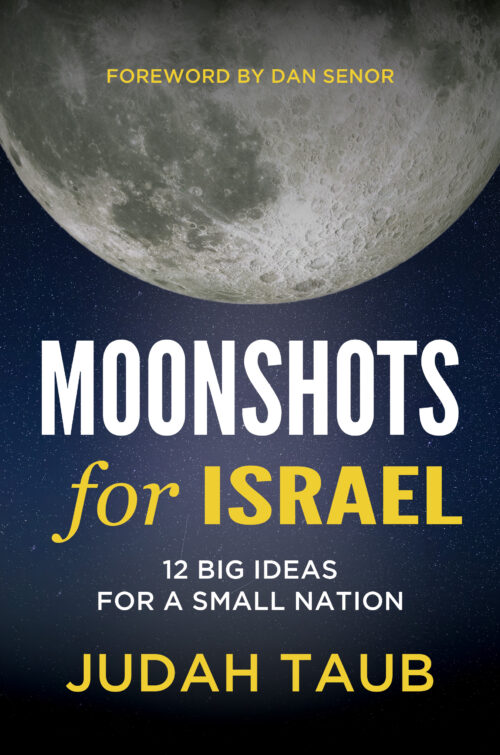

Moonshots for Israel: 12 Big Ideas for a Small Nation
By Judah Taub
From one of Israel’s leading venture capitalists comes twelve bold nation-scale ideas for transforming the country’s future—and a call to recover the ambition that built it.
On October 7, 2023, everything changed—and yet, in the corridors of Israel’s institutions, so much stayed exactly the same. In the aftermath, Judah Taub spent hundreds of days in reserve duty, leading tech teams to solve urgent battlefield problems. He came back asking a different question: not how Israel could catch up, but how far beyond its institutions it could leap toward a bolder future.
Moonshots for Israel is his answer. Applying the same rigor he brings to evaluating startups—where his team meets over 1,400 companies a year and backs only a handful—Taub set a single, uncompromising bar. Each idea had to possess the potential to transform an entire sector while surviving the scrutiny of the country’s leading experts. The result is twelve ambitious, concrete proposals, spanning water and energy, defense and medicine, artificial intelligence, education, and Israel’s connection to the diaspora, alongside a sovereign wealth fund built to secure future generations.
At its heart, this is a book about a mindset. Israel was itself a startup once—an audacious idea pursued against all odds. Taub argues that the deepest lesson of October 7 is not despair but the urgent need to rediscover that founding spirit: to see the country not only as it is but as it could be, and to build accordingly.
Practical, optimistic, and unafraid, Moonshots for Israel is a rallying cry for a generation ready to take it on.